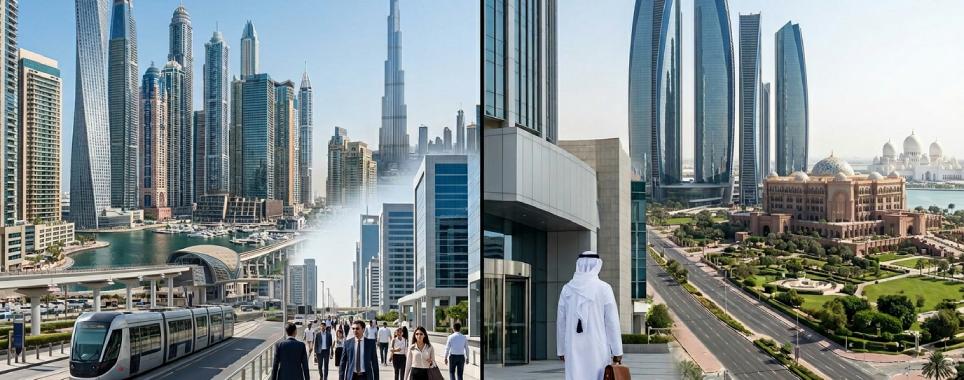
Dubai vs Abu Dhabi Business Setup: Which Emirate Should You Choose
By Site Admin • 07-Apr-26 • 366 views
The UAE is one of the most business-friendly countries in the world — but when it comes to setting up your company, the emirate you choose matters more than most people realise.
Dubai and Abu Dhabi are both world-class destinations for entrepreneurs and corporations alike. Yet they serve very different business profiles, industries, and ambitions. Picking the wrong one can mean higher costs, a mismatch with your target market, or missing out on sector-specific incentives that were designed precisely for your industry.
This guide breaks down everything you need to know — from licensing costs and free zones to lifestyle, talent, and long-term growth potential — so you can make the right call before you invest.
Why the Choice Matters
Both Dubai and Abu Dhabi fall under UAE federal law, meaning corporate tax rates, VAT regulations, and visa frameworks are the same. However, the differences lie in:
- The sectors that thrive in each emirate
- The cost of setup and real estate
- The free zones available and their specialisations.
- Access to government contracts and institutional clients
- The speed of business registration and banking
Let's break these down.
Dubai: Built for Speed, Scale, and Global Trade
Dubai has spent the last three decades positioning itself as the world's most connected business hub. With over 30 freezones, a GDP that is more than 90% non-oil, and a visa policy designed to attract global talent, Dubai is the default choice for most entrepreneurs — and for good reason.
Who Should Set Up in Dubai?
Dubai works particularly well for:
- E-commerce and retail businesses — Dubai's logistics infrastructure and ports (Jebel Ali is the largest in the Middle East) make it the natural home for product-based businesses.
- Technology and startups — Free zones like Dubai Internet City, Dubai Silicon Oasis, and Dubai CommerCity are tailor-made for tech companies and digital businesses.
- Tourism, hospitality, and F&B — With over 17 million tourists annually, Dubai is the top destination for consumer-facing businesses.
- Trading and import/export companies — Dubai's location at the crossroads of Asia, Africa, and Europe, combined with Jebel Ali Port and Dubai World Central airport, makes global trade seamless.
- Professional services and consulting — Dubai's large expat community and corporate ecosystem ensures a steady pipeline of clients for consultancies, law firms, and advisory businesses.
Key Free Zones in Dubai
Dubai Multi Commodities Centre (DMCC) is consistently ranked the world's number one free zone and offers over 200 permitted business activities under a single licence. Other notable zones include:
- Dubai International Financial Centre (DIFC) — for financial services and wealth management
- Dubai Internet City — for tech companies and digital media
- Jebel Ali Free Zone (JAFZA) — for trading, logistics, and manufacturing
- Dubai CommerCity — for e-commerce
- Dubai Airport Free Zone (DAFZA) — for aviation, cargo, and time-sensitive trade
Setup Costs in Dubai
Trade licences in Dubai start from approximately AED 5,750 per year in free zones, though costs vary depending on your business activity, the number of visas required, and whether you need physical office space.
Abu Dhabi: The Capital with Institutional Muscle
Abu Dhabi is the political and financial capital of the UAE and holds approximately 90% of the country's oil reserves. While Dubai has diversified away from oil, Abu Dhabi's economy is still heavily anchored in energy — but it is rapidly diversifying through strategic investment in finance, defence, culture, and technology.
If your business targets government entities, sovereign wealth funds, or large institutional clients, Abu Dhabi is not just an option — it is the right answer.
Who Should Set Up in Abu Dhabi?
Abu Dhabi is the better fit for:
- Energy, oil & gas, and renewables — ADNOC, Masdar, and the entire energy supply chain are based here. If you are in this sector, your clients are in Abu Dhabi.
- Defence and aerospace — Abu Dhabi hosts IDEX, the world's largest defence exhibition, and is a hub for defence contractors and aerospace companies.
- Financial services and investment management — Abu Dhabi Global Market (ADGM) on Al Maryah Island is a world-class international financial centre with its own common law framework and independent courts.
- Healthcare and life sciences — Cleveland Clinic, Mubadala Health, and major government-backed hospital projects are concentrated in Abu Dhabi.
- Education and research — NYU Abu Dhabi, Sorbonne, INSEAD, and several research institutes make Abu Dhabi the emirate of choice for EdTech and academic institutions.
- Construction and infrastructure — Mega projects like Saadiyat Cultural District and Yas Island Phase 2 are generating enormous demand for construction services.
Key Free Zones in Abu Dhabi
Abu Dhabi's freezone ecosystem is smaller than Dubai's but highly targeted:
- Abu Dhabi Global Market (ADGM) — for financial services, fintech, and asset management
- Khalifa Industrial Zone Abu Dhabi (KIZAD) — for manufacturing, logistics, and industrial operations
- twofour54 — for media, content creation, and broadcasting
- Abu Dhabi Airport Free Zone (ADAFZ) — for aviation and air cargo
- Masdar City Free Zone — for clean tech and sustainability-focused businesses
Setup Costs in Abu Dhabi
Trade licences in Abu Dhabi start from approximately AED 8,000 per year, and can be higher in premium zones like ADGM where regulatory standards are more stringent. Office space in Abu Dhabi is generally more affordable than equivalent locations in Dubai, which can offset some of the higher licence costs over time.
Head-to-Head Comparison on Key Factors
1. Speed of Company Formation
Dubai edges ahead here. DMCC and several other free zones can complete company registration in as little as 24–72 hours if documents are in order. Mainland DED licences in Dubai can also be issued quickly. Abu Dhabi's processes are generally efficient but slightly slower, particularly for regulated industries.
2. Banking and Financial Infrastructure
Both emirates offer strong banking options, but DIFC in Dubai and ADGM in Abu Dhabi are the two financial centre jurisdictions with their own regulatory frameworks. For most SMEs and startups, banking timelines and documentation requirements are broadly similar across both emirates.
3. Visa Allocation
Both Dubai and Abu Dhabi allow visa quotas based on your office space and licence type. A flexi-desk or virtual office arrangement typically allows 1–3 visas. A dedicated office or warehouse unlocks more. There is no significant structural advantage to either emirate on this point.
4. Market Access and Customer Base
Dubai wins on volume and diversity of consumer and commercial clients. Abu Dhabi wins on access to government-linked entities, sovereign wealth funds, and state-backed institutions. If your business is B2B and targeting public sector clients or energy companies, Abu Dhabi is where the decision-makers are.
5. Talent and Lifestyle
Both cities attract highly qualified international talent. Dubai's larger expat population and entertainment ecosystem makes it easier to attract talent, especially for younger professionals. Abu Dhabi has a slightly more residential feel and is popular among families, with lower real estate costs in many areas. If you are relocating yourself and your family, Abu Dhabi may offer a more relaxed pace of life.
6. Cost of Living and Real Estate
Office real estate in Abu Dhabi is generally 20–30% cheaper than equivalent space in prime Dubai locations. For businesses that need significant physical space — warehouses, clinics, showrooms — this can be a meaningful cost saving over time.
Can You Have Both?
Yes — and many businesses do. A common structure for growing UAE businesses is to register the company in one emirate while operating commercially across the whole country. UAE mainland companies can work across all seven emirates without restriction. Free zone companies can sell to the UAE market through a mainland distributor or by setting up a branch.
Some businesses register their holding company in Abu Dhabi's ADGM for its legal and financial framework, while maintaining an operational office in Dubai. This structure is common among wealth management firms and private equity funds.
What About the Other Emirates?
While Dubai and Abu Dhabi dominate business setup conversations, it is worth noting that Sharjah, Ras Al Khaimah, and Ajman offer significantly lower-cost licences — sometimes as low as AED 2,000–3,000 per year — and are viable options for budget-conscious entrepreneurs or those in light manufacturing and logistics. However, they generally lack the banking relationships, client bases, and global connectivity of the two major emirates.
So, Which Should You Choose?
Here is the honest answer: it depends on what your business does and who your customers are.
Choose Dubai if you are in trade, e-commerce, technology, tourism, professional services, or any business that relies on a diverse, international client base and fast execution. Dubai's ecosystem, infrastructure, and free zone variety make it the most versatile choice for most startups and SMEs.
Choose Abu Dhabi if you are targeting government entities, the energy sector, defence, or financial institutions. The capital's institutional weight, proximity to sovereign decision-makers, and world-class frameworks like ADGM make it the clear choice for businesses playing the long institutional game.
And if you are still unsure, that is exactly what we are here for.
Set Up Your Business With Vertexx KDP
At Vertexx KDP, we help entrepreneurs and companies set up across Dubai, Abu Dhabi, and all UAE free zones — with transparent pricing, no hidden fees, and trade licences delivered in as little as 48–72 hours.
Whether you have made your decision or you are still weighing your options, our team of UAE business setup specialists will walk you through the right structure, the right jurisdiction, and the right costs for your specific situation.